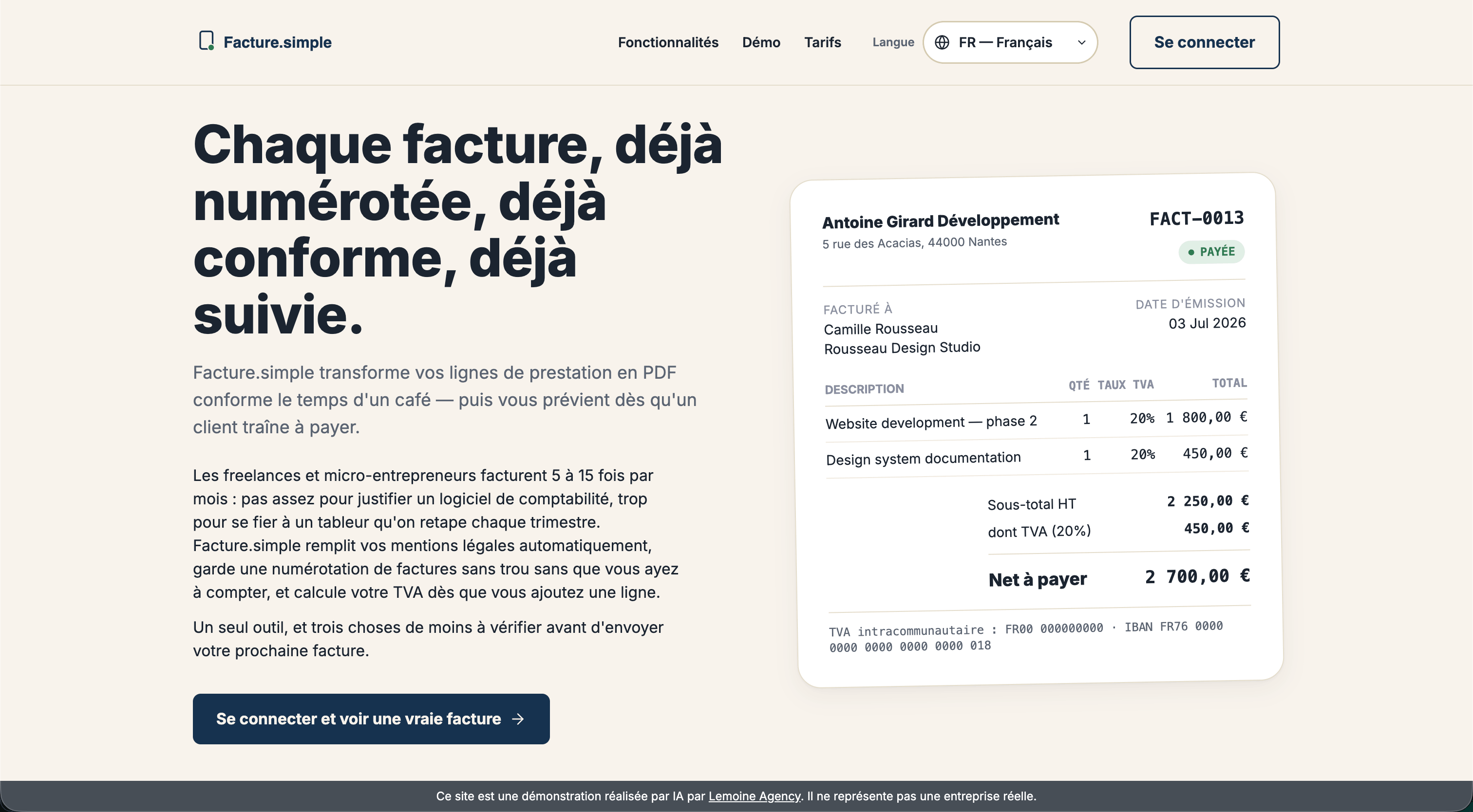
Facture.simple
Invoicing SaaS for freelancers. Bilingual, authenticated member area, persistent data, PDF exports, Supabase backend.
facturesimple.lemoine.agency
10+ years of software delivery, from human teams to AI agents
For seven years at XWiki, I led delivery on projects for SNCF, SFR and CNFPT, from project manager to production director. Today I apply the same discipline to AI agents: I break the work down, delegate it, check it, and keep the decisions that matter. Every project on this page was built with AI, and most are open source.
The pipeline orchestrates specialized AI agents, from the brief to production. Each agent has one role, and every change is reviewed before it moves forward. It delivers web applications and native iOS apps written in Swift.
The LLM writes the code. The checks that catch defects are structural, not probabilistic.
A text describing the need.
Architecture, design and content are defined, then the work is split into tasks.
Specialized agents carry out the tasks in parallel. Every change is reviewed before merge.
Automated checks, code review, security audit and end-to-end tests. Nothing ships until they pass.
Production deployment, then checks on the live application.
A working application, in production.
The pipeline itself is maintained by an autonomous fix loop that runs unattended on bugs and small, well-defined enhancements. Two separate agents take turns: one plans and codes, the other reviews the plan and then the code without ever seeing the first one’s reasoning; a deterministic script, with no AI in it, moves each issue forward and pauses it as soon as a decision from me is needed. When the loop ends, I get an alert and the fixes arrive as a single pull request, which I have Claude audit before merging. I stay hands-on for genuine new features: I then act as the link between Claude, for design, and Claude Code, for execution.
Each one started as a text brief for a fictional business. All are live.
Invoicing SaaS for freelancers. Bilingual, authenticated member area, persistent data, PDF exports, Supabase backend.
facturesimple.lemoine.agency
Law firm, Paris. Bilingual, 5 pages, 4 practice areas, attorney profiles, contact form.
durandavocats.lemoine.agency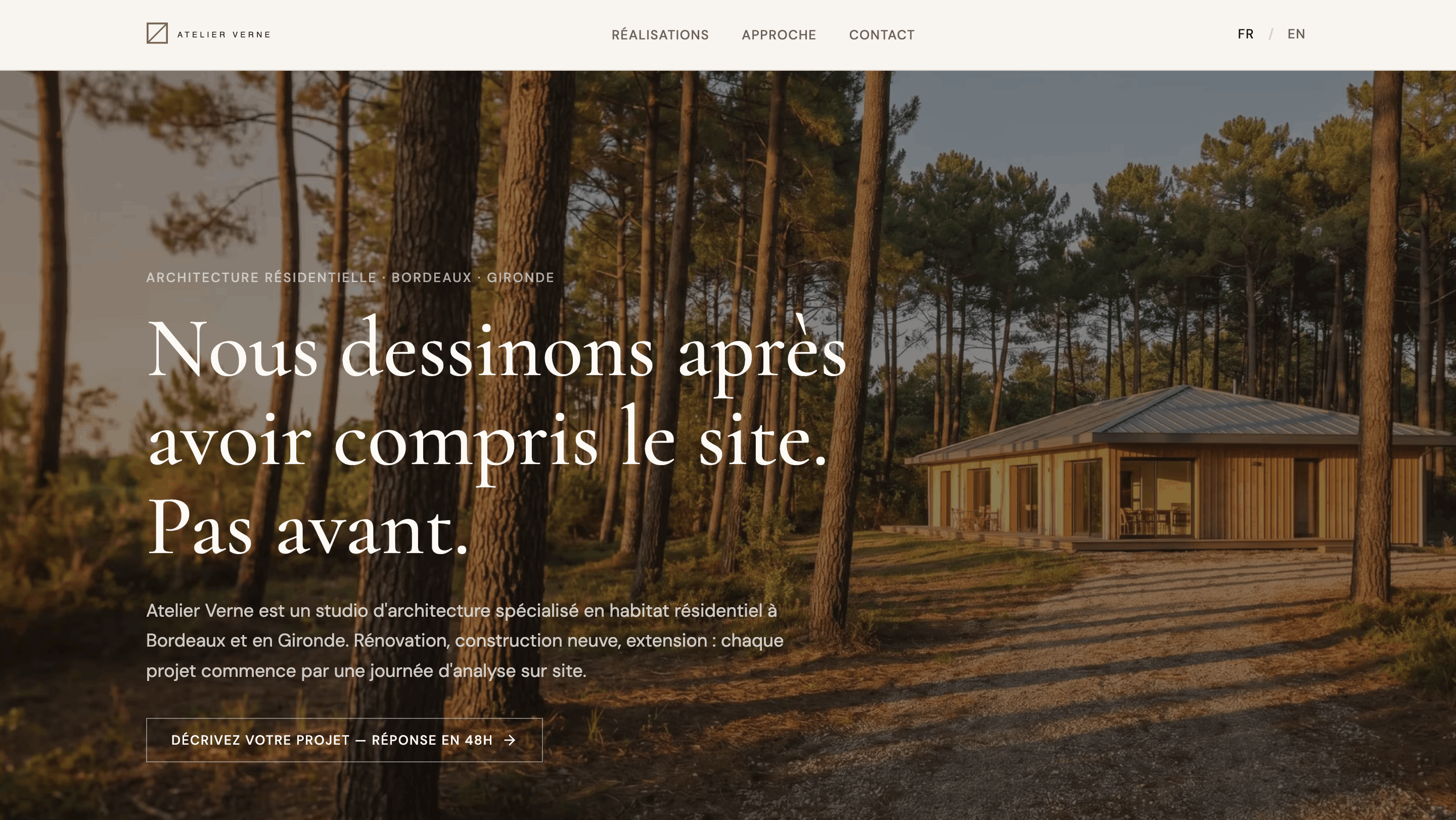
Architecture studio, Bordeaux. Bilingual, 6 project pages, bioclimatic design focus.
atelierverne.lemoine.agency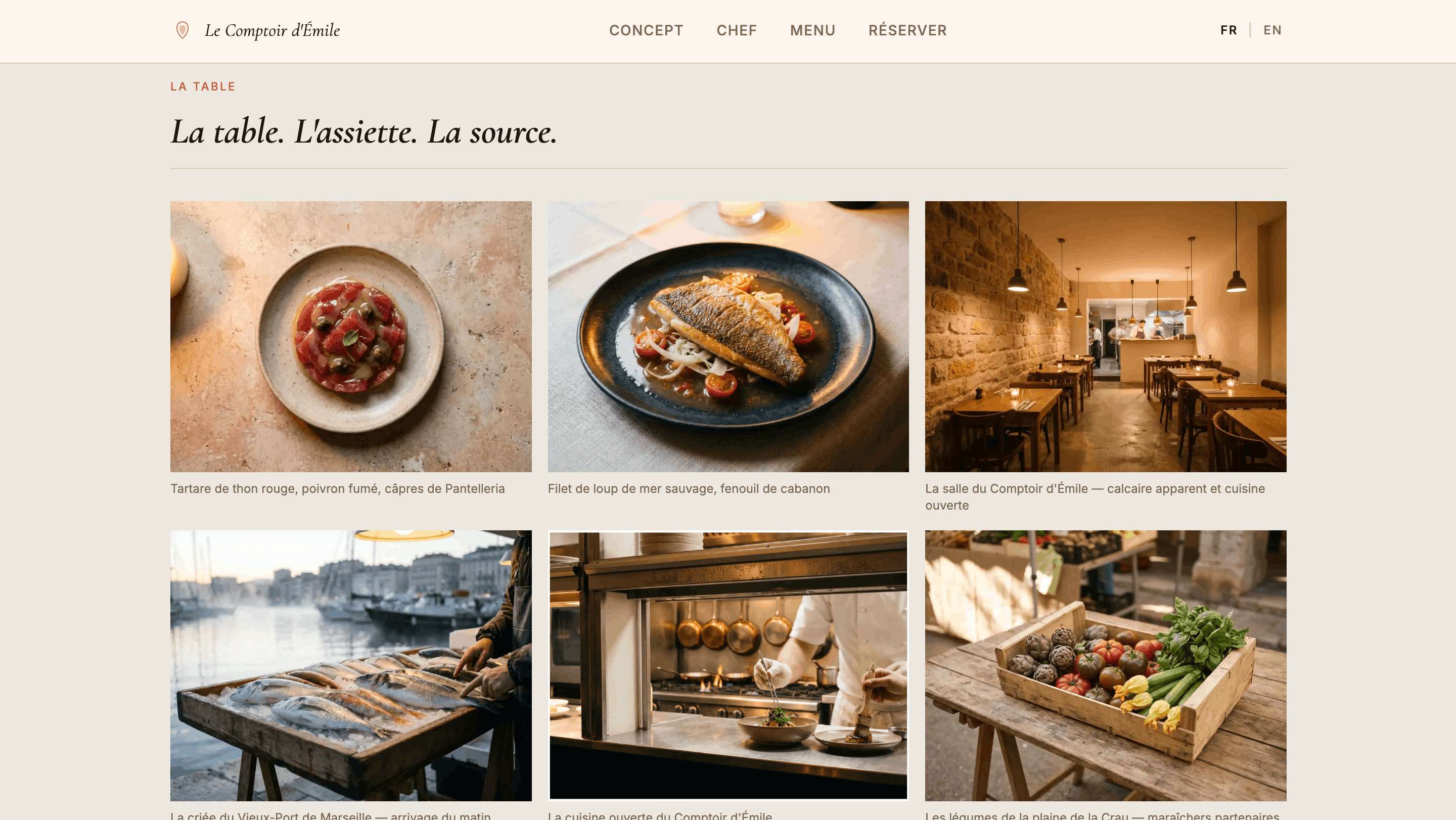
Restaurant, Marseille. Bilingual, seasonal menu with prices, chef profile, gallery.
comptoiremile.lemoine.agency
Artisan bakery, Paris. Product catalog, opening hours, Too Good To Go link.
Run: 5 hours, 3 passes
lamieancienne.lemoine.agency
Roofing company, Nantes. 5 services, past projects, quote form with validation.
toituresmartin.lemoine.agency
Physiotherapy clinic, Lyon. 5 specialties, 3 practitioners, Doctolib booking.
Run: 3 h 12, 1 pass
morelkine.lemoine.agencyThree trading projects, published as open source and built with the same method: specialized AI agents with one role each, one GitHub issue per task and a reviewed pull request for every change. The method was refined from one project to the next.
 Kiroku
Local-first trading journal, open source
Kiroku is a local-first trading journal: it runs entirely on the user’s machine and the data never leaves it. Each trade is logged (entry, exit, stop, partial targets, screenshots, emotions), then analyzed in R-multiples only, with no dollar amounts: dashboard, R distribution, time heatmap, projections, candlestick charts and an economic calendar. It is the fourth version of the same product, after a Notion template sold on Gumroad, a first version of TraderPro coded with ChatGPT, then its rebuild with Claude Code, which turned it into a SaaS with paid subscriptions.
Rebuilt from scratch with Claude Code and six specialized agents: UI design, backend, frontend, tests, code review and security review. Dedicated skills route each issue to the right agent based on its label, scaffold new components and endpoints to the project’s conventions, and check every pull request before review. The CLAUDE.md, the instruction file the AI reads, also sets the rules: no placeholder data ever, tests for every new endpoint, and six languages with identical keys.
StackPython, FastAPI, SQLite, React, TypeScript, Mantine
 Augur
AugurFutures probability engine, open source
Augur answers questions like: when the session’s first candle closes up, how often does the whole session close up too? It computes these conditional probabilities on minute-level history of NQ and ES futures, and publishes them through an API, a backoffice and an automatically generated TradingView indicator. Each probability comes with its sample size and a comparison against chance: Augur describes the past and gives no signals.
Built with Claude Code and seven specialized agents: statistics, backend, frontend, design, Pine Script, code review and tests. Each GitHub issue goes to the right agent based on its label, and every change lands through a reviewed pull request, never directly on the main branch. The CLAUDE.md also sets the domain rules the AI must follow: no statistic published without a comparison against chance, reproducible results, and tests on synthetic data for every new module.
StackPython, pandas, FastAPI, PostgreSQL, React, TypeScript, Pine Script
 Augur SaaS
Subscription platform for Augur, open source
Augur SaaS is the subscription platform built on top of Augur: sign-up, paid subscriptions through Stripe and a dashboard to browse the statistics by instrument. The site computes nothing itself: it consumes the Augur API. The public demo runs on a frozen snapshot of the results.
Built with Claude Code and three agents: UI design, frontend development and code review, with the design agent’s HTML mockups as the reference for every interface. The CLAUDE.md sets the security rules the AI must follow: the Augur API key never leaves the server, Stripe webhook signatures are always verified, and subscription access rules are never hardcoded. Before each demo release, the deployment script blocks everything if the demo data is not bundled or if the database address appears in the public code.
StackNext.js, TypeScript, Supabase, Stripe, Tailwind, Vercel
github.com/marubozu-fr/augur-saasaugur-saas.marubozu.ovhCLAUDE.md
Tools built for my own daily use. In ShowTracker and BookTracker, AI wrote the code; in AI Newspaper, it is part of the product.
 AI Newspaper
Printed daily newspaper, open source
La Crème de l’Info: a personal newspaper, printed automatically every morning. It brings together my sources (social networks, newsletters, email) and market prices (currencies, commodities, indices, crypto) in an A4 edition laid out like a real newspaper. The news, without a screen.
Here, the AI is part of the product: every morning, an orchestrator runs a content-collection agent and a market-data agent in parallel, then hands everything to Claude. Claude acts as editor-in-chief: it deduplicates stories, scores each article, drops the weakest, picks the must-reads, sorts the rest into sections, translates everything and writes the summaries, before the A4 layout and printing. The code itself was written with Claude Code directly, without a team of agents.
StackPython, Claude API, Jinja2, WeasyPrint, CUPS
 ShowTracker
TV series and movie tracker, mobile web app, open source
A mobile-first web app to track TV series episode by episode, and movies. I built it to replace TV Time, focused on two things: what I have watched, and what is coming next, with a calendar of upcoming episodes. Metadata comes from the TMDB API, and a guide covers importing an existing TV Time history.
Built with Claude Code and six specialized agents, with the same roles as in Kiroku, but written for this stack: UI design, backend, frontend, tests, code review and security review. Every issue goes through a skill that routes it to the right agent, every pull request through a quality check before it is pushed, and components and routes follow patterns written down in the repository. The CLAUDE.md enforces the security rules (API keys never exposed to the browser, RLS access rules everywhere) and records known technical pitfalls, such as Supabase’s 1,000-row limit that silently truncates results, so the AI does not repeat them.
StackNext.js, TypeScript, Supabase, Tailwind, TMDB, Vercel
 BookTracker
Personal library, mobile web app, open source
A mobile-first web app to manage my personal library: two separate libraries, novels and non-fiction, a reading status per book and a simple rating. Search queries Open Library and Google Books in parallel, and a book can also be added by scanning its barcode with the camera. The app is single-user and self-hosted: anyone who wants it deploys their own instance.
Built with Claude Code and six specialized agents, with the same roles as in Kiroku and ShowTracker, but written for this stack, and driven entirely by GitHub issues. Each feature is split into issues sequenced in a fixed order: the API and data layer first, then the design, with mockups produced by the design agent for each issue, and finally the interface built on both. The CLAUDE.md adapts the rules to the stack: with no database-level security (SQLite has none), every query must filter by user, and the production script runs lint, type checks and the build before deploying.
StackNext.js, TypeScript, Turso, Drizzle, Auth.js, Tailwind, Vercel